
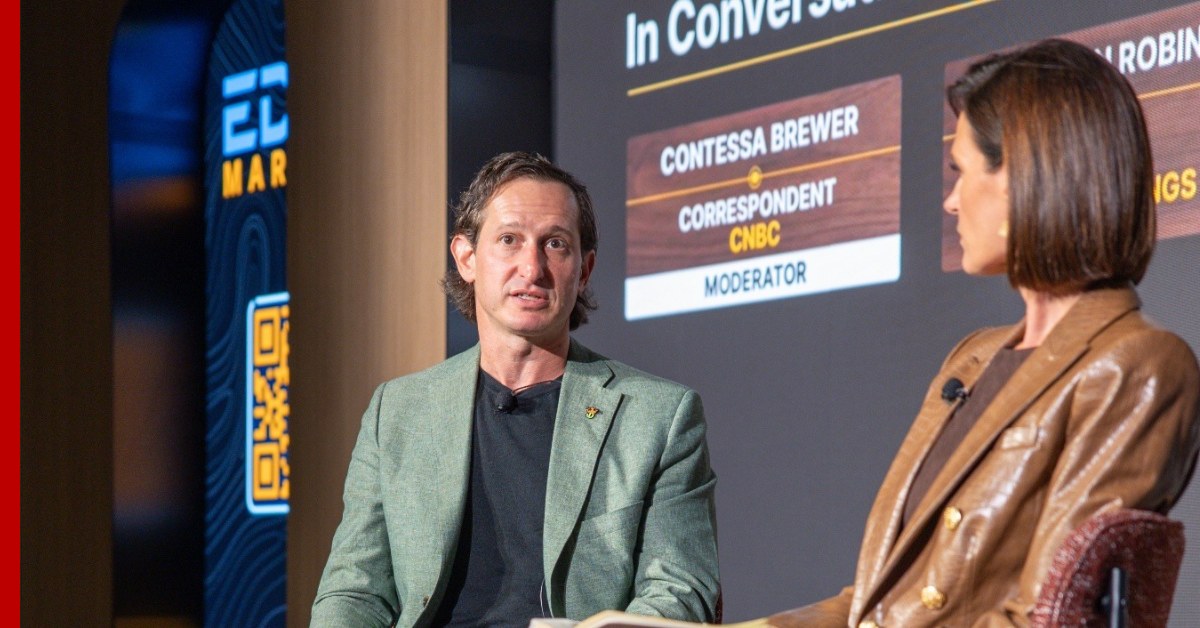
Industry figures clash over retail trader prospects, market maker economics and institutional entry as the first day of the New York event examines who stands to gain as prediction markets scale.
The opening day of NEXTPredict Summit New York repeatedly circled a single question: as the prediction market sector expands, who actually benefits?
A clash between two prominent economists in the final session of the day captured the tension. Asked whether the market is “extraordinarily skewed” towards losers, AQR principal Tobias Moskowitz dismissed the concern. “Compared to what? Do you think it’s less skewed in the stock market? It’s the same,” he said.
George Mason University economist Robin Hanson took the opposite view. “You don’t have winners unless you have losers. And so you need a lot of losers to fund the winners,” he said, arguing that markets could be built differently if someone were willing to pay for the information they produce.
The exchange underscored a day during which nearly every session asked, in one form or another, who stands to benefit from the prediction market boom.
Retail Traders Face Split Fortunes Across Market Types
Prospects for everyday traders varied sharply depending on the contracts they chose.
Microsoft Research economist David Rothschild said retail traders face a structural disadvantage in sports, where centralised data is readily available to model-makers with heavy computing power. “It is very, very hard for a retail person to just have something new and meaningful,” he said. “They are going to lose.”
By contrast, he argued that markets such as a real-time inflation gauge are where retail traders can bring genuinely useful, dispersed information, and where the industry should focus if it wants to become “a multi-trillion-dollar industry rather than a multi-billion-dollar industry.”
Signs of shifting retail interest are already emerging. Robinhood’s JB Mackenzie said the platform’s most popular event contract in September was the Federal Reserve’s rate decision, not a sporting event. “When I started doing this two years ago, it was about elections. Then it transformed into politics and sports, and now it’s moving into economics and financials,” he said.
Tools may be narrowing the gap. Moomoo US chief executive Neil McDonald, a former Citadel quant trader, said AI agents now let users build and backtest strategies in plain language. “The average retail investor has the kind of tools I had at Citadel just a few years ago,” he said.
Sportsbooks Position to Win Whatever Happens
Established sportsbooks described a hedging strategy designed to protect revenue streams regardless of regulatory outcomes.
DraftKings co-founder and chief executive Jason Robins said the company’s predictions business is already the “clear number three” exchange, despite operating in fewer than half of US states. By staying out of states where it holds a sportsbook licence, he said, DraftKings has protected its core business while building a new one. “We put ourselves in this win-win spot where no matter what the outcome of that whole process is, we are well positioned going forward,” he said of the expected Supreme Court decision on sports event contracts.
Robins also expects the tax advantage enjoyed by prediction markets to be short-lived. If sports prediction markets become permanent, he said, “states will turn to taxing it like they do sports betting.”
He was blunt about which product he thinks is better. “I think unequivocally, the sportsbook experience is a better customer experience for most customers,” he said.
Betr founder and chief executive Joey Levy said diversification will become essential across the industry, as operators look to “hedge” the risk of the Supreme Court ruling against sports contracts. “You also have a very favorable CFTC right now. But of course, that could change too,” he said.
Market Makers Emerge as Clearest Winners So Far
If one group appeared to be thriving, it was the firms on the other side of the trade.
Bernard Marantelli, founder and chief executive of White Swan Predicts, said parlay-style combination contracts placed through request-for-quote systems carried about $18bn of risk across the industry in the seven days to Tuesday, up 20% week-on-week through the first five weeks of the NFL season. “It’s going to be $30bn by Christmas or early January,” he said. “The growth rate is out of control, really.”
ProphetX co-founder and chief executive Dean Sisun said competition between market makers means exchange parlays beat sportsbook prices “95 out of 100 times,” and that there is “a lot more edge and a lot more opportunity” in these products than in main markets.
Not everyone sees that as purely positive. Levy said the economics of prediction markets are tilted towards liquidity providers, with market makers “making a lot of money that the exchanges would otherwise want to retain for themselves.”
Institutions Buying In Conceptually But Not Yet Financially
Wall Street has “bought in conceptually”, as one panellist put it, but large-scale institutional money is still some way off.
Joe Grubb, head of business development at Susquehanna Predictions, said the firm is increasingly pricing bespoke hedges for businesses, with around half of its current institutional enquiries relating to AI risks such as data centre moratoriums and legislation. “I think we’re still in the top of the first when it comes to institutional trading and institutional interest in prediction markets,” he said.
The banks, in particular, remain cautious. PJ Tabit of The Conference Board, a former Federal Reserve payments official, said the chief financial officer of a major bank had recently told him the bank does not allow accounts to interact with prediction markets “because there are huge compliance concerns.”
Not every operator wants or needs institutions to arrive. Robins said DraftKings has deliberately chosen not to build features for algorithmic and institutional traders. “The more of that you introduce into a peer-to-peer ecosystem, the faster that the retail customer will have to spend money in order to keep up,” he said.
Operators Warned Not Everyone Will Survive Spending Spree
The battle for customers is expensive, and speakers were frank that it will not end well for everyone.
Underdog founder Jeremy Levine said operators have spent “well over a billion dollars” marketing prediction markets so far this NFL season. Asked whether the industry had learned from the sportsbook spending boom that followed the repeal of PASPA in 2018, he said it was “multiplying it.” “The amount of money being splashed around right now is, it’s going to work for one or two, it’s not going to work for all,” he said.
Tomer Imber, head of Americas at customer engagement platform Optimove, drew the same comparison with the real-money gaming “gold rush” of five or six years ago, when many well-funded operators shut down because “the unit economics didn’t work.” Keeping customers after their first trade, he said, will separate “the winners and the losers in that space.”
Insiders Put on Notice
One group was told in no uncertain terms that it will not be winning: those trading on information they should not be using.
CFTC director of enforcement David Miller said there should be no doubt that insider trading laws apply to prediction markets. Less than two weeks before the midterm elections, he warned campaign staff that trading on inside knowledge such as internal polling is likely to be insider trading. “We’re going to look at that and we’ll come after you,” he said.
Miller also confirmed that the agency has a “robust investigation” into suspicious oil futures trading ahead of President Trump’s announcements on Iran, and said a Bloomberg report on the probe contained “factual inaccuracies.”
The platforms say they are watching too. Polymarket deputy chief legal officer Olivia Chalos said suspicious trading on its blockchain-based international platform is often easier to trace than on traditional venues. “I can’t think of a single case where we didn’t identify the individual almost within minutes,” she said.
The risks extend beyond the trading screen. Jenni Kennedy of the International Tennis Integrity Agency said the body is anecdotally seeing more “courtsiders” who say they have been trading on prediction markets, and more of them trying to influence players.
The Risk to Everyone
If there was one threat that could turn every group into losers, Rothschild named it in the day’s final session. “There is a lot of anti-AI, anti-crypto, anti-prediction market [sentiment] on the left, and this is an existential threat to prediction markets in the longer term if it becomes an incredibly partisan issue,” he said.
With the midterms less than two weeks away and the Supreme Court expected to rule on sports event contracts, that question will loom large over day two. Friday’s programme opens with “The Jurisdiction Gap”, on the state-versus-federal battle over sports contracts, followed by another full day of content across three stages.